
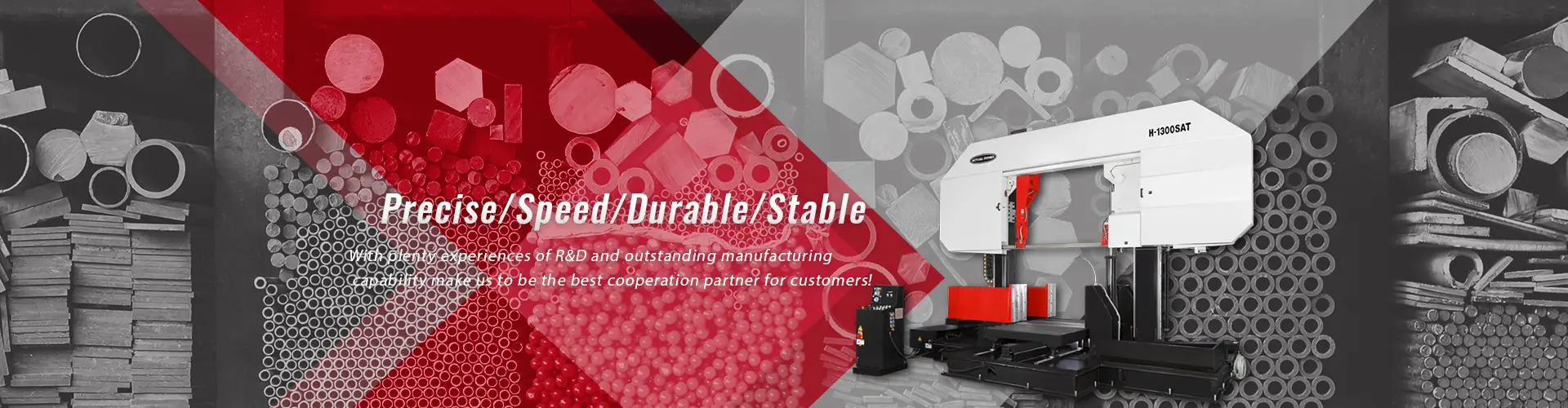
How to Choose Heavy-Duty Band Saws

Heavy-duty band saws are not simply larger band saws. They are high-load machines designed for large solid stock, alloy steel, stainless steel, and long hours of continuous cutting.
When choosing a machine, cutting capacity is not the only factor to consider. Machine rigidity, structure, and stability should also be evaluated.
This article explains what defines a heavy-duty band saw, key selection criteria, and common misconceptions, helping businesses choose a heavy-duty band saw that better matches their machining requirements.
What is a Heavy-Duty Band Saw?
A heavy-duty band saw is industrial equipment designed for high-load metal cutting. Compared to standard band saws, heavy-duty band saws typically feature a more rigid frame structure, high-power motors, a stable blade guide system, and a feed control design that maintains cutting pressure over long periods.
On the shop floor, heavy-duty band saws are used to cut large solid bars, thick-walled tubes, steel stock, and hard-to-cut materials.
Differences from Medium-Duty and Light-Duty Band Saws
| Comparison Item | Heavy-Duty Band Saw | Medium-Duty / Light-Duty Band Saw |
|---|---|---|
| Materials | Large solid bars, mold steel, alloy steel, stainless steel | General steel, tubes, profiles, small to medium workpieces |
| Cutting Load | High-load, continuous cutting | Medium- to low-load, intermittent cutting |
| Structure | Rigid and stable frame | Lighter structure |
| Motor Power | Higher | Lower |
| Accuracy | Stable during long operation | For general accuracy needs |
| Industries | Steel processing, machinery, mold manufacturing | Metal shops, repair shops, general manufacturing |
Common Applications of Heavy-Duty Band Saws
Heavy-duty band saws are used in metalworking, steel service centers, machinery manufacturing, and mold processing. Common materials include steel, structural steel, stainless steel, aluminum extrusions, mold steel, alloy steel, and profiles.
Key Factors to Consider When Choosing a Heavy-Duty Band Saw
When choosing a heavy-duty band saw, the decision should be based on actual machining conditions. Below are several key factors to consider:
1. Maximum Workpiece Size and Throat Depth
Before purchasing a heavy-duty band saw, confirm the workpiece's maximum diameter, width, height, and length. Throat depth and cutting capacity should exceed the actual material size to leave enough room for clamping, feeding, and angle cutting.
2. Material Type
Different metal materials place different demands on machine load and saw blades. Mild steel and aluminum are easier to cut. Stainless steel, mold steel, hard alloys, or high-temperature alloys require higher rigidity, stable feed rates, and a suitable saw blade.
When choosing a machine, clearly list the commonly used materials. Then evaluate whether the machine's horsepower, blade specifications, and cutting speed are sufficient.
3. Daily / Monthly Cutting Volume and Automation Level
For small-volume or intermittent processing, a semi-automatic model may be sufficient.
For high daily cutting volume, fixed-length cutting, or continuous production, an automatic model with automatic feeding, automatic clamping, and automatic cutting is recommended.
A higher level of automation can reduce manual operation time and improve production line stability.
4. Power Supply Specifications
Heavy-duty band saws require stable power. Before purchasing, confirm whether the facility supports three-phase 380V, three-phase 220V, or the machine’s required voltage. If not, a transformer or electrical adjustment may be needed.
5. Budget Range and Long-Term Maintenance Costs
Choosing a heavy-duty band saw should not be based on purchase price alone. Blade consumables, coolant, parts replacement, maintenance, and downtime costs should also be considered.
A lower-priced model with insufficient rigidity may cause faster blade wear, inconsistent accuracy, and more repairs.
6. Horsepower (HP) and Spindle Torque
A heavy-duty band saw should have sufficient horsepower and maintain stable torque output during low-speed cutting. Insufficient horsepower can lead to weak cutting force, blade binding, unstable cut surfaces, or motor overload.
7. Blade Width and Speed Range
Blade width affects cutting stability and deflection resistance. Heavy-duty cutting usually requires a wider, more rigid blade and adjustable speed for different materials and thicknesses.
Machines with variable speed control allow the cutting speed to be set appropriately for mild steel, stainless steel, alloy steel, and other materials, improving cutting efficiency and extending blade life.
8. Cooling System
Metal cutting generates heat, so cooling helps reduce blade wear, improve cut quality, and minimize deformation. Common methods include water-soluble coolant, oil-based coolant, and minimum quantity lubrication.
For high-hardness materials or long cutting cycles, confirm the coolant flow rate, nozzle position, and chip removal design.
9. Guide Rails and Feed Method
Guide rails and feed methods affect cutting pressure and cut surface accuracy:
- Manual feeding is suitable for small-volume processing.
- Hydraulic feeding stably controls the descent speed, making it suitable for general heavy-duty cutting.
- Servo feeding provides even more precise pressure and speed control.
For heavy-duty processing, unstable feeding must be avoided, as it can easily cause blade deflection or breakage.
10. Noise Reduction and Vibration Damping
During heavy-duty cutting, the band saw blade, workpiece, and machine structure are placed under higher loads. If vibration damping is insufficient, it may affect cutting accuracy and the operating environment.
When choosing a machine, pay attention to the machine base rigidity, saw frame stability, the guide structure, and the clamping system.
A good vibration-damping design can reduce noise, minimize cutting marks, and extend the service life of the band saw blade and the machine.
11. Safety and Ergonomic Design
A heavy-duty band saw should include safety guards, emergency stop switches, overload protection, and blade breakage detection. The control panel, clamping fixtures, blade replacement area, and maintenance space should also support safe operation.
Common Misconceptions When Choosing a Heavy-Duty Band Saw
Misconception 1: Any Double-Column Band Saw Is a Heavy-Duty Machine
A double-column structure can improve saw frame stability and reduce deflection and vibration during cutting. It is an important foundation for a heavy-duty band saw.
However, a double-column design does not automatically make a machine heavy-duty. Whether the machine is suitable for heavy-duty cutting still depends on its overall rigidity, saw frame and base design, hydraulic feed system, spindle horsepower, torque output, and other configurations.
A standard double-column model may still be suitable only for general materials or medium-load processing.
Misconception 2: Standard Models Can Also Cut Heavy Materials
A standard band saw may be able to cut some thick or hard materials, but this does not mean it is suitable for long-term heavy cutting.
If a standard model is used to process large solid stock, alloy steel, stainless steel, or high-hardness materials, it may lead to faster blade wear, cutting deflection, lower cut surface accuracy, and even increased load on the motor and machine structure.
Misconception 3: Choosing Equipment Based Only on Price
A heavy-duty band saw is production equipment intended for long-term use. The initial purchase price should not be the only point of comparison. Equipment stability and durability are far more important than the upfront cost.
If a lower-priced model has insufficient rigidity, unstable feed control, or inadequate horsepower, it may lead to higher costs for saw blade consumables, repairs, and downtime later on.
Misconception 4: Ignoring Actual Processing Conditions
Before purchasing a band saw, gather complete processing information, including material types, workpiece dimensions, whether the material is solid stock, material hardness, daily or monthly cutting volume, and the desired cut surface quality.
Without clarifying actual processing conditions, selecting a machine based only on size or specifications may lead to unsuitable equipment. A professional manufacturer can evaluate the right model based on material, dimensions, hardness, and production volume.
Conclusion
When choosing a heavy-duty band saw, the decision should be based on actual machining requirements. A model with a rigid structure, stable feed control, sufficient horsepower, and well-designed safety features can better balance cutting efficiency, accuracy, and equipment service life.
Actual Power is a Taiwan-based professional band saw manufacturer offering a range of heavy-duty band saw machines, including the H-800SAT, H-1080SAT, H-1100SAT, H-1300SAT, H-7062NC, and H-1080NC series. These machines are suitable for large solid stock and high-load metal cutting applications.
Looking for a heavy-duty band saw? Contact us for a professional evaluation of your material type, workpiece dimensions, cutting frequency, and machining requirements.